Composting for Beginners: A Simple Backyard Setup
Riley Hofmann
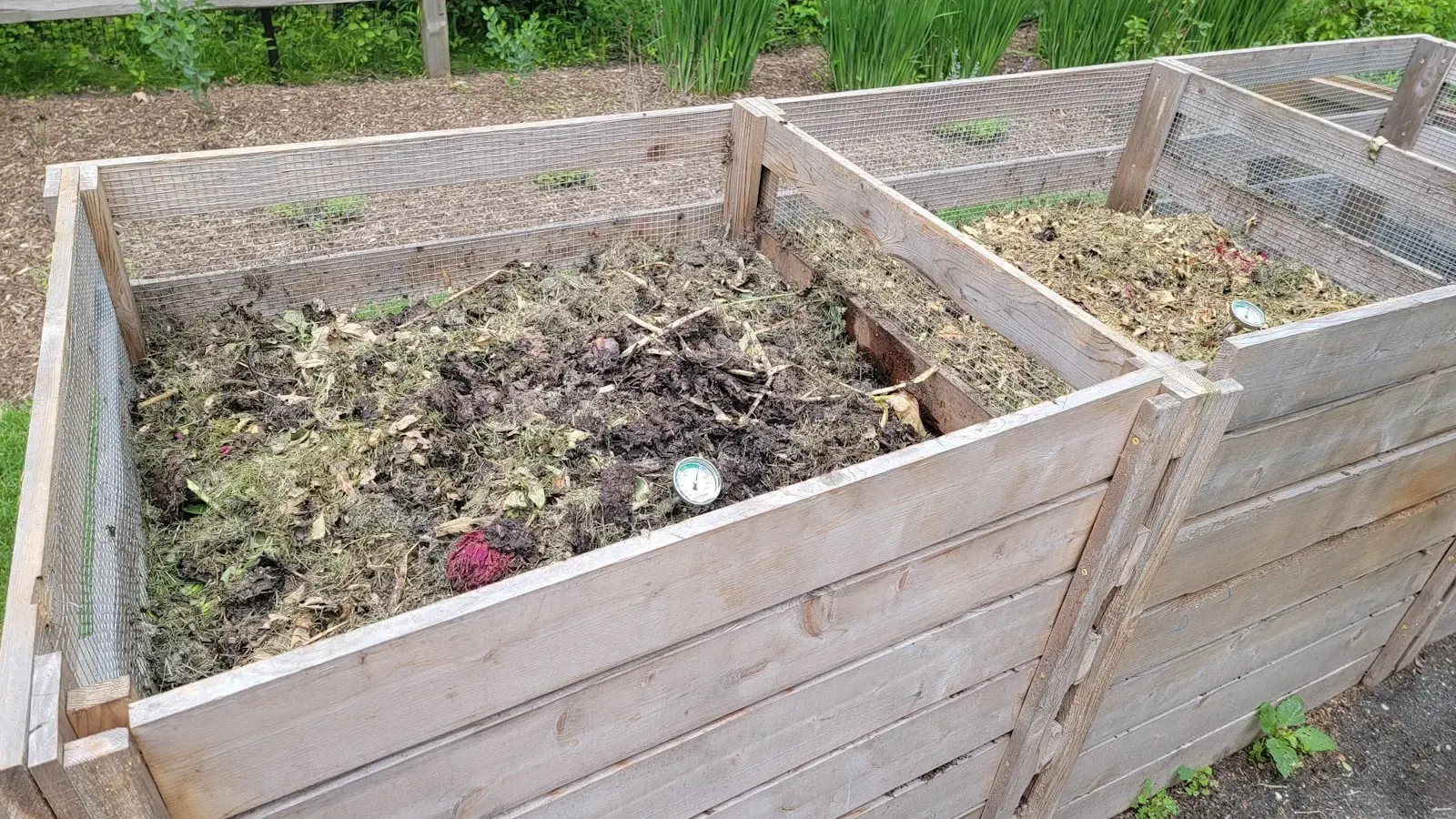
Composting is just stacking carbon-rich dry material and nitrogen-rich wet material in a pile big enough to heat up, then leaving it alone long enough to break down. That's the whole thing. The rest is optimization.
The reason to bother: finished compost is the 30% of your raised bed soil mix that you'd otherwise buy by the bag, every season, forever. I bought bagged compost my first season before I started a pile. Haven't bought a bag since.
Browns and greens
Every compost guide talks about browns and greens, and it just means carbon-rich versus nitrogen-rich:
- Browns (carbon): dry leaves, straw, shredded cardboard (tape and glossy print removed), paper, wood chips from untreated wood, dead plant stems
- Greens (nitrogen): vegetable scraps, coffee grounds and the paper filter, fresh grass clippings, garden trimmings
Aim for noticeably more browns than greens by volume. A pile that's too green goes slimy and smells like ammonia. A pile that's all browns just sits there doing nothing for a year. The science behind that ratio is roughly 25 to 30 parts carbon for every 1 part nitrogen by weight. Nobody's weighing kitchen scraps to hit that exactly, but 2 to 3 parts browns to 1 part greens by volume gets you close enough.
Pile size and location
Size matters more than people expect. A pile needs to be at least 3 feet by 3 feet by 3 feet to hold enough heat to break down efficiently, and no bigger than about 5 feet per side or the center won't get air.
- Put it somewhere well-drained and easy to reach year-round: convenience beats optimal sun exposure
- Sun or shade both work as long as you're managing moisture
- Start with a base layer of coarse browns like twigs to keep air moving underneath
A bin isn't required. An open pile works fine.
Open pile, bin, or tumbler
If you do want something to contain it, the common options trade off differently. NC State Extension covers the details on each.
- Wire or pallet bin: cheapest, easy to build in an afternoon, fine for most backyard volumes
- Three-bin system: one bay filling, one breaking down, one finished, good if you're composting steadily all season
- Tumbler: easiest to turn and fully sealed against rodents, but holds less volume and costs more upfront
A single wire bin covers a typical backyard setup. Move to a three-bin system once you're feeding more than one raised bed or generating a lot of yard waste.
What to keep out
- Meat, fish, dairy, and grease: they attract rodents and smell terrible
- Pet waste from dogs and cats: pathogen risk in a food garden
- Diseased plant material: a home pile often doesn't get hot enough to kill pathogens reliably, so clear it out rather than compost it
- Weeds that have gone to seed, unless your pile genuinely runs hot
- Grass clippings treated with herbicide in the past few weeks: the chemical can survive the pile and stunt whatever you grow with the finished compost later
- Black walnut leaves and hulls: they contain juglone, which stays toxic to tomatoes and other vegetables even after composting
Keeping it going
Two things to manage: moisture and air. The pile should feel like a wrung-out sponge: damp, not dripping. If it's dry, it stalls; if it's soaked, it goes anaerobic and starts to stink.
Turning the pile every few weeks speeds things up a lot by getting air into the middle. You can skip turning entirely, but then you're waiting closer to a year instead of a few months. UConn Extension has a practical walkthrough of both approaches.
A few common problems and their fixes:
- Fruit flies: exposed food scraps sitting on top. Bury new greens a few inches under existing browns each time you add them, and they mostly clear out within a week
- Rodents digging in: same fix, plus double-check that no meat or dairy snuck in. A pile that's properly buried and free of animal products rarely draws them
- Compacted and airless even with the moisture right: the material was probably piled too fine, like all grass clippings with nothing coarse mixed in. Toss in some straw or shredded cardboard to open it back up
Mistakes that stall a first pile
A few things trip up almost every first-timer:
- Building the pile too small: under 3 feet per side, it can't hold heat and just sits there
- Piling on fresh grass clippings without mixing in browns: they mat into a solid, airless layer and go slimy fast
- Tossing in whole branches or corn stalks: they take years to break down whole, so chop or shred anything woody first
- Composting in a low spot that floods after rain, which drowns the pile and turns it anaerobic
- Letting the pile dry out completely in summer heat and forgetting about it until fall
How to tell when it's finished
Finished compost is dark, crumbly, and smells like forest floor: earthy, not sour or sharp. You shouldn't be able to identify what any of it originally was. If you can still pick out recognizable vegetable scraps, give it more time.
Putting it to use
Work an inch or two into the top of your soil, or spread it on top as mulch and leave it alone. Either way it feeds the soil over weeks as it keeps breaking down, not all at once like a synthetic fertilizer.
Fall and spring both work. Applying in fall gives it a head start before planting. Spring is fine too if that's when the pile finishes. Compost isn't a full soil replacement on its own. It's the organic-matter third of a raised bed mix, not a stand-in for the other two-thirds. It's also what makes heavier feeders like corn or squash worth trying in a companion planting layout without relying on nitrogen-fixing beans to carry the bed.
Frequently asked questions
- How big does a compost pile need to be?
- At least 3 feet on each side (roughly 3x3x3) to hold enough heat to break down efficiently, and no larger than about 5 feet per side so air can still reach the center.
- What is the right ratio of browns to greens?
- Noticeably more browns (dry, carbon-rich material) than greens (wet, nitrogen-rich material) by volume. Too many greens turns the pile slimy and makes it smell like ammonia.
- Why does my compost pile smell bad?
- Almost always too many greens, too much moisture, or not enough air. Add dry browns, turn the pile to get oxygen into the middle, and the smell usually clears within days.
- Can I compost meat and dairy?
- Not in a backyard pile. They attract rodents and create strong odors. Stick to plant material, coffee grounds, and yard waste.
- How long does compost take?
- A few months if you turn it regularly and keep the browns-to-greens balance and moisture right. Closer to a year if you build the pile and never touch it again.
- Does composting work through winter?
- It slows down a lot in freezing temperatures but doesn't fully stop. Keep adding to the pile through winter, and it picks back up on its own once temperatures rise in spring.